Shedding Light(s) –
A view into the Collection #11

How does light influence our perception of space and time? What artistic, philosophical and social meanings can it have? And how is our approach to light changing as a result of digital technologies?
Light makes things visible, creates atmosphere and shapes how we perceive spaces and forms. Its role in art has changed considerably over the centuries. Shedding Light(s) shows how artists use light as a creative force, as a symbol and as a visible theme.
Light appears in the collection presentation in different ways: as a medium, as a motif, as a metaphor.
As a medium, it becomes the material of art itself – in projections, reflections or luminous bodies, light becomes a spatial experience and is transformed into energy, movement and perception. As a metaphor, it stands for knowledge, spirituality or hope, but also for power and transience. Finally, light becomes the subject of depiction as a motif. In painting, photography and graphic art, artists explore how light can be captured, bouned or staged – between fleeting appearance and permanent form.
The collection presentation is presented in the context of the exhibition All light. Light and Space Yesterday and Today shown.
The works in these audios come from our collection and show how differently artists have dealt with the subject of light in different art styles and epochs.
Other stations that deal specifically with the works from the exhibition All Light. Light and Space yesterday and today can be found here.
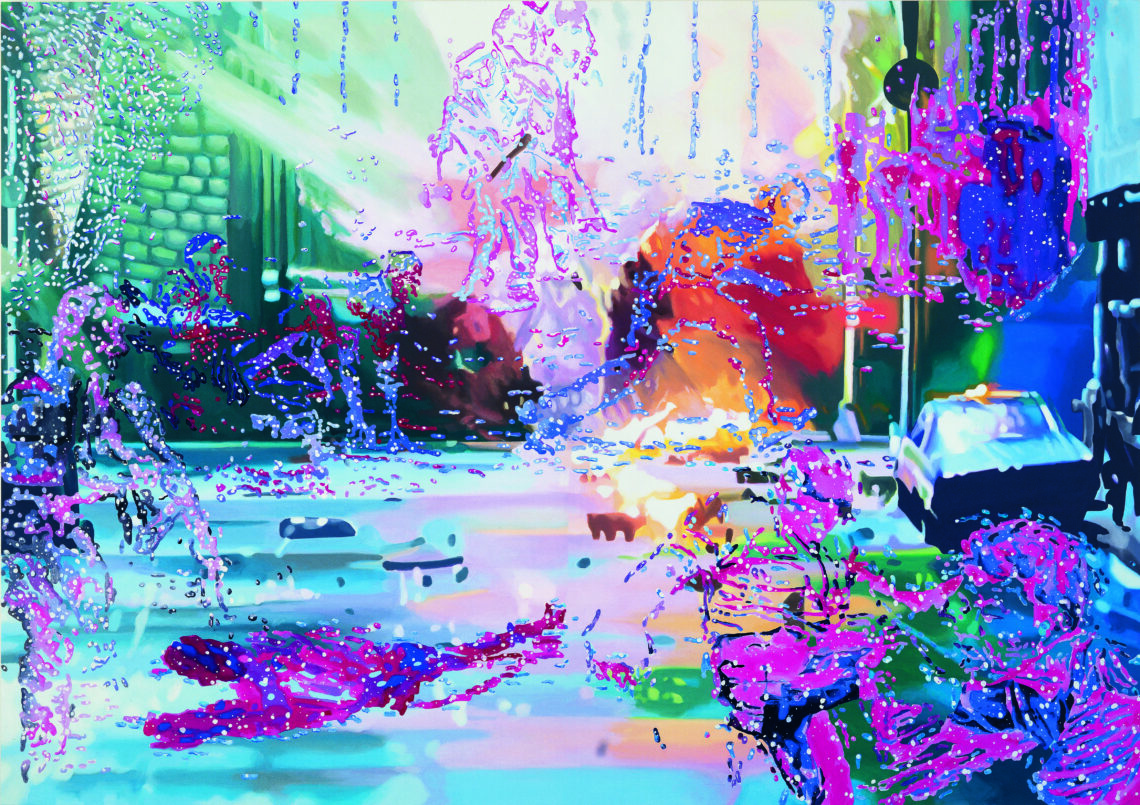
Large, flowing pink shapes full of dots or eyes spread across the almost square canvas. The strict rectangles are arranged almost like falling blocks. Cartoonish creatures, perhaps fish or birds, appear to be playing on and between them. The forms are interconnected, nothing is isolated, everything seems to be in motion. Even the color scheme seems to change.
How this effect is achieved is particularly exciting: the artist has used a special interference color. Depending on how you move in front of the work, the color of the pink areas changes – sometimes they glow intensely, from other angles they become completely gray and inconspicuous. The picture literally invites you to join in: Your own movements determine the change of light and how you perceive the work of art.
Charline von Heyl is one of the most important contemporary painters today. She was born in Mainz in 1960 and grew up in Bonn. After studying under Jörg Immendorff and Fritz Schwegler, she moved to New York in 1994. She has lived here and in Marfa, Texas, ever since. Von Heyl has not abandoned traditional painting, but asks anew what painting actually is. She creates works with great intellectual acuity, but also with humor and playful elements. It is above all movement and the change of direction and speed that fascinate von Heyl. She herself says: “No other art form offers these different tempos of simultaneous perception.” With this philosophy, she creates works that remain on the surface of the canvas while revealing deep meanings – magical and enigmatic. This is shown by “Bunny Hex”.
Text: Matthias Albrecht
Audio by: Matthias Albrecht
Recording, editing and technical realization: Matthias Albrecht, Nadine Kleinken (Digitale Museumspraxis Kunsthalle Bielefeld)
Imagine you’re sitting in a drive-in waiting for the movie to start. Then something unusual happens: you don’t see the film itself on the screen, but the pure light of the film projector. This is exactly what Hiroshi Sugimoto shows you with this photograph. The Japanese artist did the following: He set up his camera in the movie theater and captured the entire film in exactly one photo. Because the exposure time of the photo was just as long as the film – two hours. This means that the light from the film images projected one after the other is collected. In this one photo, it merges into a single, radiant white rectangle. The movie content is gone, but something else suddenly becomes visible – the blank surface of the screen, the traces of light from airplanes in the sky and the surrounding landscape at night. The artist himself once said of this effect: “I imagined it to be very interesting and mysterious, even religious in a way.”
Sugimoto thus makes something fundamental clear: light is not just there. Light is the material itself with which we create images. Because if there is no light source, no photo or film can be taken. Even on a movie screen or digital monitor, images only become visible through light.
Sugimoto’s work combines two ideas from the “All Light” exhibition: light becomes both the material and the message. This is very much in the spirit of the Light and Space Movement of the 1960s, which used light not only as a means, but as an artistic medium in its own right.
Further works from Hiroshi Sugimoto’s theater series can be discovered at KB Kosmos.
Text: Matthias Albrecht
Audio by: Nadine Kleinken
Recording, editing and technical realization: Matthias Albrecht, Nadine Kleinken (Digitale Museumspraxis Kunsthalle Bielefeld)

You are looking at a painting full of light and color – “Jeanne à l’ombreille, Cavalière”, painted in 1906 on the French Mediterranean coast. Henri Manguin’s wife Jeanne can be seen sitting under gnarled trees and catching the sun with her orange parasol. Notice how the warm yellowish light captures her left leg, while the rest of the figure is in cool shades of purple and blue. The parasol – painted in intense orange – itself becomes a source of light, the luminous point of the picture. And can you see the light blue sea in the background? Together, they create a scene imbued with southern warmth and vibrant colors.
Manguin was one of the Fauves, or “savages” in German. This was a revolutionary group of artists at the beginning of the 20th century. They wanted to express emotions with pure, bright colors and used light in new ways. Before the Fauves, 19th century Impressionism – such as Claude Monet’s – had attempted to reproduce the effect of natural light as faithfully as possible. Impressionists explored how colors change under different lighting conditions. It was different before that: artists in the Baroque period around 200 years earlier used light dramatically to create depth and grandeur.

With Manguin and the Fauves, light is liberated: it is not simply a means of making objects visible. It doesn’t have to document, it doesn’t have to dominate. Instead, light becomes an immediate force of expression – the pure joy of light, the emotional perception of the moment. As with the artists in the “Alles Licht” exhibition, light is not only understood as brightness, but as an artistic medium in its own right. It creates atmosphere and changes how we perceive the world. Here, at Manguin, you can already feel it: the artist is not sharing an image with you, but a sensation – the experience of light itself.
Text: Matthias Albrecht
Audio by: Matthias Albrecht
Recording, editing and technical realization: Matthias Albrecht, Nadine Kleinken (Digitale Museumspraxis Kunsthalle Bielefeld)
The narrow white circle surrounded by black may remind you of the image of a solar eclipse. Otto Piene often focuses on the sun as a pure, powerful symbol. But where does this aesthetic come from?
Piene was one of the founders of the ZERO movement, which emerged in Düsseldorf in 1957. ZERO literally means “zero point”. This refers to a new beginning in art after the turmoil of the Second World War, a zone of stillness and concentration from which something new can emerge. Piene and his colleagues wanted to liberate art from the emotional heaviness that often prevailed in German society at the time. They were looking for purity, simplicity, reduction to the essentials. Light, air, fire – these were their new materials.
Otto Piene often chooses fire from the natural elements for his works. From the 1960s onwards, he created fire paintings in which flames are the actual artists: With their smoke, they leave natural traces on the canvas – unpredictable, lively, powerful. Here, in screen printing, Piene translates this energy into a different language. It alludes to the sun as the primal form, as the concentration of all energy. For Piene, the sun stood for life, for light, for the highest and purest. It is not just a motif – it is a symbol of his entire artistic philosophy: concentration on the essentials, a new beginning from nothing.
Text: Matthias Albrecht
Audio by: Nadine Kleinken
Recording, editing and technical realization: Matthias Albrecht, Nadine Kleinken (Digitale Museumspraxis Kunsthalle Bielefeld)