Play, Life, Illusion. Xanti Schawinsky + Monster Chetwynd “Xanti Shenanigans”
+ Monster Chetwynd. Xanti Shenanigans
From March 15 to June 15, 2025, the Kunsthalle Bielefeld is presenting the exhibition “Play, Life, Illusion. Xanti Schawinsky” with the intervention “Xanti Shenanigans” by Monster Chetwynd.
The exhibition is the first comprehensive retrospective of the early Bauhaus artist Alexander “Xanti” Schawinsky (1904-1979) in Germany for over 35 years. Schawinsky’s multidisciplinary work is characterized by the spirit of the Bauhaus, where the artist studied in the 1920s, and Black Mountain College, where he taught in the 1930s. The creative means with which the artist has experimented in the six decades of his work include staging, stage design, photography, graphic design, painting and typography. The exhibition reviews his entire career, from his early works, which are characterized by questions of stage space and the relationship between man and machine, to his process-oriented paintings from the 1950s and 1960s. As part of the exhibition, Monster Chetwynd (*1973) will conceive the expansive installation “Xanti Shenanigans”, which refers to Schawinsky’s work.
The exhibition is organized in cooperation with the Mudam Luxembourg – Musée d’Art Moderne Grand-Duc Jean in collaboration with the estate of Xanti Schawinsky.
Guest curator: Raphael Gygax
The exhibition is sponsored by the Kulturstiftung Kunsthalle Bielefeld and the Kulturstiftung Dr. Dagmar Nowitzky.


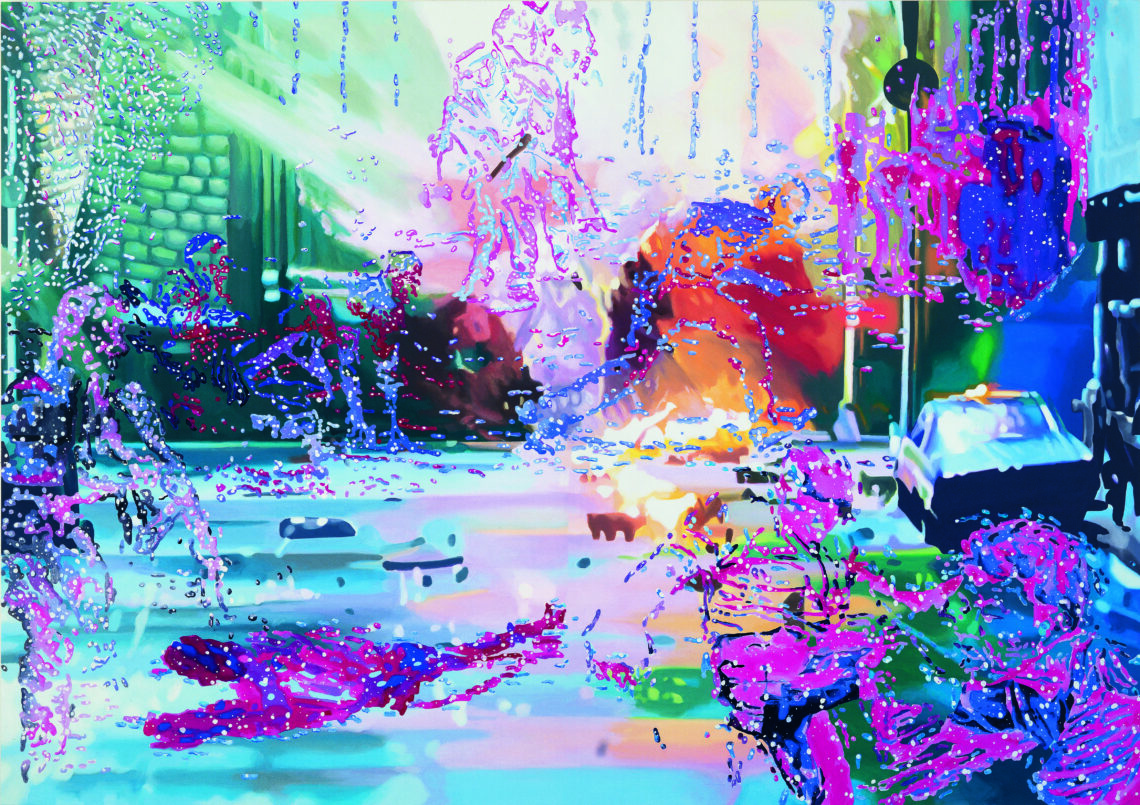
Welcome to “Xanti Shenanigans”! British artist Monster Chetwynd has created this colorful installation inspired by Xanti Schawinsky’s experimental spirit.
These large-format, colorful lengths of fabric were created using a special technique: the artist drove a car through paint and then over the fabrics. This is an allusion to Schawinsky’s own “Track Paintings”. Schawinsky wanted to expand the boundaries of painting and therefore had the idea of painting pictures by car in the 1950s.
Take a closer look at the materials: Chetwynd deliberately uses simple, everyday fabrics such as cotton and linen, which she works with bold, bright acrylic paints. Typical of her working method is the renunciation of perfection – the spontaneous traces, imprints and superimpositions are intentional and show her processual approach: we should see how the artist has proceeded. The texture of the surfaces literally invites you to feel the movement with which they were created.
Chetwynd is known for their colorful, carnivalesque performances and their rather less than perfect homemade aesthetic. She often works with a permanent ensemble of friends and family members, most of whom are not professional actors. This collaborative way of working reflects her belief that art should be accessible and collaborative. For the exhibition opening, she transformed the entrance hall into a living stage – very much in the spirit of Schawinsky’s own theater experiments at Black Mountain College. The performers brought the exhibition to life with handmade costumes, lively music and improvised dance.
Incidentally, “Shenanigans” means something like “pranks” or “mischief” – a reference to Chetwynd’s respectful but joking approach to Schawinsky’s legacy. She is not afraid of humor and the absurd, which makes her art particularly lively. The raw, almost childlike elements in her aesthetic are no coincidence, but a conscious decision against the often elitist art world.
“I’m interested in rediscovering stories that have almost been forgotten,” says Chetwynd. With this installation, she creates a bridge between Schawinsky’s experimental Bauhaus spiritand our present day – full of energy, color and playfulness.
Text: Matthias Albrecht
Audio by: Matthias Albrecht
Recording and editing: Matthias Albrecht, Nadine Kleinken (Digital Museum Practice Kunsthalle Bielefeld)
Xanti Schawinsky at the Bauhaus
That was life at the Bauhaus in the 1920s: A place full of creative energy, where art, design and experimentation went hand in hand. For the young Xanti Schawinsky, it was a time of intense inspiration and new friendships.
During the day, he attended courses with the so-called Bauhaus masters, i.e. professors such as László Moholy-Nagy, Wassily Kandinsky and Paul Klee.
“With Kandinsky, we drew and explored the realm of color,” Schawinsky later recalled.“We created large still lifes, compositions of objects that at first glance did not seem to belong together.”
In the evenings, the students met in their studios in the Prellerhaus, the residential building of the Bauhaus. A formative encounter for Schawinsky was with Kurt Schmidt:
“One day someone said in passing: ‘Do you want to come to my studio tonight? Eight o’clock. Third floor, Prellerhaus. Kurt Schmidt. Some friends.”
This fleeting invitation led to a creative collaboration in experimental theater.
Together with friends such as Herbert Bayer and Marcel Breuer, Schawinsky also played jazz in the legendary Bauhaus-Kapelle. Bauhaus festivals were famous – from the “Metallic Festival” to spontaneous costume parties. In this collaborative atmosphere, the boundaries between work and play, between art forms and between teachers and students became blurred.
Text: Matthias Albrecht
Audio by: Matthias Albrecht
Recording and editing: Matthias Albrecht, Nadine Kleinken (Digital Museum Practice Kunsthalle Bielefeld)
Additional material: Video showing the Tiller Girls (1930).
Transcription of the audio
“I was fascinated by the rhythmic precision, had iron fittings attached to the soles of my shoes and wanted to push it to virtuosity with jazz music. Then I designed several tap machine figurines – a kind of mechanized tap apparatus, but abstractly based on the human figure, as a counterpart to the tuxedoed tap dancer with chapeau clacque. Some of the scenes in our performances arose from this; the inspiration from America could not be denied. Tiller girls, jazz, tap[dance], the banjo, saxophone, the drum battery, the Black spirituals and their lyrics. Who could escape this western wind? […]”
This quote reflects Xanti Schawinsky’s enthusiasm for tap dancing and the new music from the USA at the time. He invented the “tap machine” for several stage plays. Here you can see the preparatory drawings for a painting showing her. The machine was also available as a built object: it consisted of an abstract figure made of wood, paint and metal with two tapping feet that produced the rhythmic tap dance.
The composition of the machine is typical of the Bauhaus: Schawinsky has constructed a figure reminiscent of a dancing person from a few geometric shapes such as a cylinder, rectangles and circles. He stretches out one arm and tilts his head to the side. To the right of the machine stands a man in top hat and tails.
Which character seems more alive to you? Man or machine?
Xanti Schawinsky seems to have reversed the roles here, don’t you think?
In the quote, Schawinsky mentions the Tiller girls. This was a globally successful dance group at the beginning of the 20th century. It also made frequent stops in Germany. Below we have linked a recording of a performance by these dancers from 1930.
Text: Matthias Albrecht
Audio by: Nadine Kleinken
Recording and editing: Matthias Albrecht, Nadine Kleinken (Digital Museum Practice Kunsthalle Bielefeld)
“The production [revolved] around Olga, our [new] ballet dancer[…]. She appeared on the balcony as an impossible Juliet and was serenaded by several Romeos. When the scene changed to Adam and Eve, there was a gunshot and a murder that went unnoticed by the actors. The backdrop walls were moved again […]. Every now and then a word was spoken, more for effect than for meaning, because the word had no relation to the events. The same three-minute gramophone recording was played again and again over a large loudspeaker.”, Xanti Schawinsky, around 1970
A man in white make-up with a Tyrolean hat, goatee and swimming trunks: this is how Xanti Schawinsky plays a part in his play. The main character is played by Manda von Kreibig, dancer and ballet master at the Landestheater Darmstadt and the Stadttheater Nürnberg. The Bauhaus colleagues Oskar Schlemmer, Hermann Röseler and T. Lux Feininger can also be seen in other roles. The play “Olga, Olga” is performed with great success at the Bauhaus carnival ball on February 21, 1928. It makes it clear what Xanti Schawinsky’s work is all about:
The Bauhaus Theater was not intended to be a place for great tragedies – Schawinsky did not want to create a reinterpretation of serious plays, but rather a playful examination of the modern world. The actors played from the moment and improvised. The stage plays often incorporated elements of technology, design and machine culture with a wink. Sometimes new materials were taken for a ride, sometimes the role of mechanization in society was questioned – topics that were usually worked on seriously at the Bauhaus. The pieces were often accompanied by minimalist music that determined the rhythm of the movements.
“The performance was full of kitsch, action and speed. But there was no clear meaning. Every interpretation was left to the individual spectator. That’s equilibristics: you use the things of everyday life in relation to fantasy without giving an answer to anything. You go further – you jump out of the frame with your idea.”, Xanti Schawinsky, around 1970
“Olga Olga” is considered a forerunner of the performance art that emerged in the 1960s. In contrast to Oskar Schlemmer’s rather static sculptural theater, Schawinsky’s work is characterized by dynamism and randomness. The artist Monster Chetwynd also uses this type of approach for her performances. Their backdrops and documentation can be found in the entrance hall and garden hall of the Kunsthalle. You have probably already noticed the similarity of the colors and shapes of the stage constructions used. Monster Chetwynd deliberately refers to Xanti Schawinsky in the works shown here.
Oskar Schlemmer’s work is also represented in the collection of the Kunsthalle Bielefeld. His “wire figure Homo” was shown alongside Xanti Schawinsky’s work in the exhibition “Context: Bauhaus”. Click here for the corresponding media guide article. You can find information on our second work by Oskar Schlemmer at KB Kosmos.
Text: Matthias Albrecht
Audio by: Nadine Kleinken
Recording and editing: Matthias Albrecht, Nadine Kleinken (Digital Museum Practice Kunsthalle Bielefeld)
Can you imagine spontaneously acting in a play right now while the stage is constantly changing?
This work is more than just a model – it is a stage for a “total theater” in which color, space, light and movement interact. Colors, shapes and lines move – but not by themselves. Behind them are actors who control them, interact with them and bring them to life. Think back to your childhood for a moment: just as you might have played with colorful building blocks, Schawinsky experiments here with movable architectural elements that can be rotated, moved and tilted.
Schawinsky had already begun developing these so-called “spectodramas” during his time at the Bauhaus, where he studied and taught from 1924 to 1929. After fleeing Germany, Schawinsky brought these revolutionary ideas to Black Mountain College in the USA in 1936, where he developed multimedia productions with his students.
Take a moment and imagine how the elements are set in motion – this is how architecture is transformed into a living theatrical experience.
The work was created with tempera, pencil and ink on paper.
Text: Matthias Albrecht
Audio by: Matthias Albrecht
Recording and editing: Matthias Albrecht, Nadine Kleinken (Digital Museum Practice Kunsthalle Bielefeld)
Here you can see six sheets from Schawinsky’s portfolio “The Album”. Xanti Schawinsky put them together after his time at the Bauhaus.
Album? It sounds a bit like a photo album, but there is more to it: the artist produced this portfolio with a total of 70 individual collages from around 1929 – it may have been created in the early 1930s or even after his emigration to the USA in 1936. The sheets are not dated.
What is so special about it? Each sheet is an independent graphic composition. Schawinsky selected images from different phases of his life – shots with Bauhaus colleagues, friends and family are juxtaposed with travel impressions or preparatory sketches for his artistic work. The photographs and documents are not simply lined up chronologically, however, but arranged artistically – similar to a template for a print layout.
In addition to the experimental handling of the image material, a clear structure is maintained. The Bauhaus imprint is unmistakable in this. “The Album” gives us a deep insight into Schawinsky’s life at the Bauhaus and beyond. It is both a personal memento and an artistic work that he later continued at Black Mountain College in the USA.
Text: Matthias Albrecht
Audio by: Matthias Albrecht
Recording and editing: Matthias Albrecht, Nadine Kleinken (Digital Museum Practice Kunsthalle Bielefeld)
His time after the Bauhaus
From Bauhaus via Italy to the USA
After fleeing Germany in 1933, Xanti Schawinsky settled in Milan, where he worked as a graphic designer at the newly founded Boggeri advertising studio. The Bauhaus influence remained unmistakable in his work: his clear, functional design language and experimental use of typography revolutionized Italian advertising graphics in the 1930s. His innovative designs for well-known companies such as Illy Caffé, Cinzano and Olivetti contributed significantly to the international reputation of the advertising studio.
In Italy, Schawinsky was operating on politically sensitive terrain. He also designed works in line with the party line, such as a propaganda poster for the twelfth anniversary of the so-called “fascist revolution”, which depicted Mussolini as the “head of the masses”. Nevertheless, his position as an artist of Jewish-Polish descent was increasingly jeopardized as Italy drew closer to National Socialist Germany.
Schawinsky left Italy in 1935. After his marriage to Irene von Debschitz in London, he emigrated to the USA in 1936. There he continued his career at the renowned Black Mountain College. Here he taught drawing and color theory and brought the new ideas of the Bauhaus stage to the United States with multimedia installations.
The advertising poster is an offset print.
Text: Matthias Albrecht
Audio by: Matthias Albrecht
Recording and editing: Matthias Albrecht, Nadine Kleinken (Digital Museum Practice Kunsthalle Bielefeld)
As you look at this photo, ask yourself: what are moments when all people are equal – whether royal or peasant?
The “Dance of Death” was originally a medieval pictorial motif that showed how death takes all people indiscriminately. Schawinsky transported this idea into the modern world in his play “Danse Macabre”.
At the performance at Black Mountain College in 1938, the audience sat in a circle around an arena-like stage. They themselves were wrapped in dark cloaks of death. The play presented twelve characters – from the king and cardinal to the simple worker and child – who all encounter death.
What makes this work so special is that Schawinsky combined his Bauhaus experience with the latest developments in the field of theater. The music by John Evarts and texts from medieval requiem masses such as the “Dies Irae” emphasized the serious atmosphere.
Text: Matthias Albrecht
Audio by: Nadine Kleinken
Recording and editing: Matthias Albrecht, Nadine Kleinken (Digital Museum Practice Kunsthalle Bielefeld)
Transcript of the audio see below.
Additional information:
The ambivalence of war
The background consists of a color gradient from one color to white to another color. It looks a little as if the “faces” are floating in front of a rather fake-looking sky. The tension between the bold colors and the disturbing content is particularly fascinating in “The Soldier”. This dichotomy reflects Schawinsky’s complex attitude to the war.
Have you ever noticed how often we experience contradictory feelings in everyday life? How a movie can entertain and disturb us at the same time? Or how technological progress improves our lives and creates new problems at the same time? It is precisely this dichotomy that Schawinsky captures in his work.
A new form of expression
“The Soldier” marks a clear break with Schawinsky’s earlier, more optimistic works. While he developed playful and experimental art forms at the Bauhaus and later at Black Mountain College, this work and the others in the series show a fundamental insecurity.
The work was created with watercolor, tempera and colored pencil on paper.
Transcript of the audio
“These cheerfully colorful and at the same time disturbing man-machines speak of a very ambivalent view of war.” With these words, Xanti Schawinsky himself described the works in his “Faces of War” series, which also includes “The Soldier” from 1942.
When Schawinsky created “The Soldier”, he had already been living in New York for four years. The years 1941 and 1942 marked an intensive confrontation with the Second World War for him. Among other things, he worked for the US Air Force, where he designed camouflage patterns – an activity that had a lasting influence on his artistic work.
While Schawinsky was living in relative safety in America, he received disturbing news from Europe: his brother had been taken prisoner after fighting against the Nazis. His mother died out of concern for her son. Many of his friends and relatives in Germany had “completely disappeared or been killed”, as he himself put it.
“The Faces of War” show hybrid beings – half human, half machine. The human face is made up of technical elements.
Think about your own experiences with technology: maybe your smartphone has almost become part of your body? Your car or bike is certainly an extension of your mobility. But Schawinsky’s hybrid goes further – here, man does not merge with a useful technology, but with a destructive one. There are only a few works in which he reacts so directly to political events. But with them he created an impressive testimony to the dehumanization caused by war – a topic that has unfortunately lost none of its topicality.
Text: Matthias Albrecht
Audio by: Nadine Kleinken
Recording and editing: Matthias Albrecht, Nadine Kleinken (Digital Museum Practice Kunsthalle Bielefeld)
“Camouflaged Outpost” marks a turning point in Schawinsky’s artistic development. During the Second World War, he designed camouflage patterns for the American Air Force – an experience that had a lasting impact on his artistic work.
The concept of camouflage reflects experiences you may be familiar with: How often do we ourselves try to hide our true feelings or blend in? Here in the painting, war equipment is camouflaged: a gun, presumably used for air defense, is overlaid with areas of color in shades of red, green and blue.
Little remains of the clear Bauhaus aesthetic in Schawinsky’s earlier works. Instead, you now encounter dreamlike landscapes and distorted perspectives. These surrealist elements were very probably influenced by Giorgio de Chirico. Schawinsky was impressed by his serious-looking pictures with empty seats and long shadows. The artists had met in the 1940s.
The “Faces of War” series also belongs to this new work phase. In it, Schawinsky created hybrid portraits that combined human faces with technical or organic structures – a clear break with the light-heartedness of his earlier works.
The work was created with watercolor, tempera and colored pencil on paper.
Text: Matthias Albrecht
Audio by: Matthias Albrecht
Recording and editing: Matthias Albrecht, Nadine Kleinken (Digital Museum Practice Kunsthalle Bielefeld)
Imagine that pictorially: Xanti Schawinsky attached absorbent plates to his shoes, dipped them in white paint and then – accompanied by music – danced across the screen. Every step, every turn and every jump left a unique mark.
Think of your own footprints in the sand on the beach or in the snow. The traces we all leave behind in life are similarly fleeting – only rarely are they immortalized as they are here. But immortalization was not Schawinsky’s main goal. He wanted a different kind of painting. Throughout his life, he experimented with new ways of creating images beyond the brush, taking inspiration from Abstract Expressionist artists such as Helen Frankenthaler and Jackson Pollock. After the Second World War, they were also looking for new opportunities for painting.
“Totality can be approached through an increased mobilization of physical resources,” wrote Schawinsky in 1969 in his essay “About the Physical in Painting”. He wanted to go beyond the boundaries of traditional painting and use his whole body as a tool. This makes him a forerunner of what would later be known as performance art, in which the body and the action performed with it are the medium of art.
In “Danza Blanca” you don’t just see an image, but the echo of a unique dance – a recording of the movement that can never be repeated in exactly the same way.
Text: Matthias Albrecht
Audio by: Nadine Kleinken
Recording and editing: Matthias Albrecht, Nadine Kleinken (Digital Museum Practice Kunsthalle Bielefeld)
Second audio to Xanti’s essay “About the Physical in Painting” (1969).
Transcript of the first audio
An artist at work. He paints and dances at the same time!
It is not an ordinary act of painting, but a performative art action.
Between 1956 and 1960, Schawinsky developed this revolutionary technique as part of his artistic exploration of the “physical in painting”. Instead of working traditionally with a brush and easel, he attached blocks of paint to his feet. He placed the canvas on the floor and danced across it. These spontaneous, rhythmic movements left traces of color in random patterns – a direct imprint of his physical presence and movement.
Schawinsky himself described his approach in a letter in 1962:
“[…] The thought [sits] in every muscle, in every fiber and in every movement […] of which man is capable – and that the word is more capable of perhaps illustrating this thought, with luck. The pictorial, however, is direct; without detour via illustration, and can evoke a universal experience with the fewest means and in the limitation to a tiny alphabet.”
Transcript of the second audio
Does the brush have to be the most important tool in painting?
Let’s think about this art form for a moment. Xanti Schawinsky wanted to radically rethink painting. In 1969, he published an essay entitled “About the Physical in Painting” . In it, he formulates new ways of creating paintings. He was inspired by artists such as Yves Klein and Jackson Pollock. Both were known for understanding painting not just as a picture on a canvas, but as a physical, almost theatrical act. The process was just as important to her as the finished work of art itself.
Schawinsky took a very similar view. He spoke of a “totality” in art – painting that involves the entire body, that invents new tools and that understands the production process to be just as important as the finished picture. In his essay, he explains in ten points how this new type of painting could emerge. They work almost like instructions.
Why is that so exciting? Because it takes up the idea that art does not always have to be created by artists themselves. By formulating his methods as “instructions”, Xanti Schawinsky could theoretically take his ideas further – the artist takes a back seat and the viewer’s imagination takes center stage. This principle is similar to the ideas of conceptual art in the 1960s.
So Xanti Schawinsky didn’t just want to create new pictures – he wanted to fundamentally change our understanding of what painting is. In his works, he brings this idea to life through color, movement and experimentation. What would be your … Experiment with painting?
Text: Matthias Albrecht
Audio by: Nadine Kleinken
Recording and editing: Matthias Albrecht, Nadine Kleinken (Digital Museum Practice Kunsthalle Bielefeld)
If you drive a car through a puddle, you leave wet tire tracks on the dry asphalt behind it. Xanti Schawinsky has used precisely this everyday process for his art!
“Come Closer” from 1960 is part of his “Track Paintings” series. For these works, the artist actually drove his sports car through black oil paint and then criss-crossed over brightly pre-painted canvases laid out on the floor.
So what you see here are not lines created with a brush, but real tire tracks from a car – perhaps the symbol of technological progress in the 20th century. The title “Come Closer” says: Come closer and discover the dynamic traces of this unusual artistic action!
Having previously danced across canvases with his“Dance Paintings“, Xanti Schawinsky has now replaced his body with a car.
Text: Matthias Albrecht
Audio by: Nadine Kleinken
Recording and editing: Matthias Albrecht, Nadine Kleinken (Digital Museum Practice Kunsthalle Bielefeld)
Smoke as a painting tool: Schawinsky’s Smoke Paintings
Have you ever observed how smoke rises from a candle and draws fine, constantly changing patterns in the air? Or how soot particles settle on a pane of glass? It was precisely this everyday phenomenon that Xanti Schawinsky developed into a sophisticated artistic technique in the 1960s.
For his “Smoke Paintings” from 1964, Schawinsky did not use a drop of paint except for priming the canvases! Instead, he captured smoke and fixed the fine traces of smoke directly onto fiberboard. He artfully solidified the volatile smoke into permanent, fascinating patterns.
This experimental technique emerged in his late creative phase, in which he continued to work on overcoming the boundaries of traditional painting. After his dance paintings and car paintings, he now explored how to create images without brushes and paint.
The “Smoke Paintings” reflect Schawinsky’s lifelong fascination with the ephemeral and his ability to transform everyday phenomena into poetic works of art. They make visible what normally remains invisible.
Text: Matthias Albrecht
Audio by: Nadine Kleinken
Recording and editing: Matthias Albrecht, Nadine Kleinken (Digital Museum Practice Kunsthalle Bielefeld)
Layer by layer: Schawinsky’s spray paintings
Have you ever folded a sheet of paper several times or crumpled it up and then drawn on it? Xanti Schawinsky used precisely this principle for his “spray paintings” of the 1960s.
He took his canvases, folded them several times and then sprayed them with fine layers of paint. When he then unfolded the canvas again, surprising patterns and color gradients emerged – almost like an inkblot game that you may remember from childhood or art class. The many layers of paint create an impressive depth effect. Schawinsky has been developing the technology for over 20 years, since the 1940s.
In his “Eclipse” series, he used this technique to create almost three-dimensional images. The inspiration for this was the personal experience of a
“Eclipse” – or solar eclipse, as it is called in German. In 1966, Schawinsky built himself a house on Lake Maggiore in Italy. His works now reflect the natural experience of the alpine mountain world.
This experimental technique shows once again how much Schawinsky was interested in new ways of painting throughout his life. Instead of working traditionally with a brush and easel, he explored how paint and canvas can interact in unusual ways – almost like a game.
Text: Matthias Albrecht
Audio by: Matthias Albrecht
Recording and editing: Matthias Albrecht, Nadine Kleinken (Digital Museum Practice Kunsthalle Bielefeld)
Transcript of the audio see below.
Additional information:
The art of illusion: related techniques in the stage area
For centuries, theater has used various techniques to create illusions and captivate audiences. These techniques have constantly evolved with technological developments, although some traditional methods are still used today. In the following, the most important related techniques in the stage area that are used to create visual illusions are explained.
Pepper’s Ghost: A Victorian illusion technique with a modern twist
Probably the best-known historical illusion technique in the stage area is “Pepper’s Ghost”, a method popularized by Professor John Henry Pepper as early as 1862. This technique caused a sensation at the time when it was first presented on Christmas Eve 1862 at a performance of Charles Dickens’ “The Haunted Man and the Ghost’s Bargain” and even the future King Edward VII was impressed.
The basic principle of Pepper’s Ghost is the use of a large pane of glass that is positioned at a certain angle to the stage. If a brightly lit actor is placed below or to the side of the stage, his reflection appears on the glass pane, giving the audience the impression of a transparent ghost on stage. By simply switching off the spotlight, the “ghost” can disappear instantly.
In modern applications, this technology is often combined with video projection. Instead of using live actors, images are projected onto a screen, the reflection of which then appears in the glass. Today, this technology is used in a variety of ways in theme parks, museums and even at concerts, where it is often mistakenly referred to as “holographic”.
Semi-transparent mirrors and mirror films
A related technique that is often used on stages are semi-transparent mirrors or so-called one-way or spy mirrors. These are reflective on one side and transparent on the other, which creates special visual effects.
In a stage context, such semi-transparent mirrors are often combined with lighting effects. A shiny surface or mirror appears to the audience, behind which light effects, points of light, shadows and three-dimensional effects can be created, resulting in fascinating optical illusions. An important prerequisite for this technique is that the area being observed is darker than the area to be observed.
Projection mapping: three-dimensional illusions
A more modern technique that has become increasingly important in recent years is projection mapping. This involves the precise projection of images onto non-flat surfaces, which offers countless possibilities in the theater sector.
With projection mapping, the stage set can be changed without stagehands having to physically intervene. It enables the creation of surreal environments and offers new ways of immersion for the audience. This technology is used in various contexts:
- Stage mapping: This involves using projections across several levels on the stage and in the entire event space. This can be used as an opening effect, as a transitional element or as background music for presentations.
- Element mapping: Individual objects can be brought to life through projection, such as “The Cube”, a combination of 3D projection mapping and artistic performance.
- Architectural and façade mapping: This is where the technique was first applied. Buildings are given a colorful surface or brought to life with animations.
Regardless of the specific techniques: Illusion is a fundamental element of theater. “Without illusion there is no theater, without the capacity for illusion theater becomes a bland and sometimes lazy affair.”
Transcript of the audio
Move to the left and right in front of this work as you look at it. Pay close attention to how it changes as a result. Exciting, isn’t it?
What you see is an optical illusion. For this work, Xanti Schawinsky stretched a layer of gauze – a fine, transparent fabric – over a canvas and sprayed it with paint. This creates floating parallelograms that change depending on your point of view.
With his gauze pictures, Xanti Schawinsky did not create an immovable object, but a changing space that actively involves you as the viewer. What you see depends on where you stand. This simple insight makes “Untitled” almost emblematic of Schawinsky’s lifelong artistic research into space, movement and perception.
Incidentally, Xanti Schawinsky’s use of gauze to create optical effects is unique in art. In the theater, on the other hand, something similar is still used today: Semi-transparent mirror films are used together with lighting effects or projections to create optical illusions. This creates a shiny surface for the viewer that can be used to create light effects, shadows and 3D effects. You can find out more below.
Text: Matthias Albrecht
Audio by: Matthias Albrecht
Recording and editing: Matthias Albrecht, Nadine Kleinken (Digital Museum Practice Kunsthalle Bielefeld)
Gallerie